
The dream of wearing a white coat is a powerful motivator for students across Pakistan. It represents years of hard work, late-night study sessions, and a deep desire to serve the community. However, as we approach the MDCAT preparation 2026 season, it's clear that the path to medical school is becoming more competitive and strategy-driven.
Success in the MDCAT isn't just about how many hours you put in; it's about how well you understand the requirements of the test. With recent updates to the syllabus and exam structure, having a clear roadmap is essential.
This guide is designed to provide you with everything you need to know to navigate your MBBS admission in Pakistan journey with confidence, whether you are an FSc student, an A-Level candidate, or a repeater aiming for a top score.
Table of Contents
Eligibility & Merit Criteria
Before diving into the core subjects, it's important to understand the basic requirements set by PMDC. These standards ensure that all candidates have a strong academic foundation before entering the medical field.
Academic Eligibility
For the 2026 cycle, the academic bar remains high. Students are required to have a minimum of 65% marks in HSSC (Pre-Medical) or an equivalent qualification (such as A-Levels).
Understanding the Aggregate Calculation
Your final merit is calculated using a formula that balances your past academic performance with your performance on the day of the entry test. The aggregate calculation typically follows this breakdown:
- Matriculation (SSC/Equivalent): 10%
- Intermediate (HSSC/A-Level): 40%
- MDCAT Score: 50%
Because the MDCAT accounts for half of your total merit, it acts as the ultimate "weight shifter." Even if your FSc marks are slightly lower than your competitors, a high score in the entry test can significantly boost your overall standing.
Passing Marks & Standards
To qualify for admission into a medical or dental program, you must meet the minimum passing marks. For the 2026 session, these are generally:
- MBBS: 55%
- BDS: 50%
Meeting these passing marks is the first step toward becoming a healthcare professional. Now that we've covered the basics, let’s look at the structure of the exam itself.
MDCAT 2026 Exam Pattern
Last year, the structure of the MDCAT has evolved to become more streamlined and focused.
Subject-Wise Weightage Breakdown
The revised distribution places a massive emphasis on your core medical foundation. Biology now accounts for nearly half of the entire test, making it the primary factor in your final merit.
| Subject | No. of MCQs | Weightage | Focus Level |
|---|---|---|---|
| Biology | 81 | 45% | CRITICAL |
| Chemistry | 45 | 25% | HIGH |
| Physics | 36 | 20% | HIGH |
| English | 09 | 5% | MODERATE |
| Logical Reasoning | 09 | 5% | MODERATE |
| TOTAL | 180 MCQs | 100% | 180 Minutes |
Key Exam Features
- No Negative Marking: You are encouraged to attempt every single question. Even a guessed answer could be the point that secures your admission.
- Difficulty Matrix: The paper is balanced to ensure fairness. Typically, 15% of questions are easy, 70% are moderate, and the final 15% are hard. These "hard" questions are often multi-step numericals or complex logic puzzles designed to distinguish top-tier candidates.
- Paper-Based Format: While digital tools are great for prep, the actual exam remains a paper-based MCQ test, so practicing with physical bubble sheets is a must.
For a more detailed breakdown of each subject, explore our comprehensive guide on the MDCAT test pattern.
Targeted Strategies
Your MDCAT preparation strategy 2026 must be built around your current academic commitments. There is no "one size fits all" when you’re balancing board exams or a gap year.
A. MDCAT Prep for FSc Students
If you are a fresher, your biggest enemy is time. You are currently in the thick of your 2nd-year syllabus while the MDCAT looms just a few months after your boards.
- The Overlap Strategy: Focus on the "High-Yield" topics that are common to both your HSSC-2 boards and the MDCAT (e.g., Reproduction, Growth & Development, and Transition Elements). Mastering these now means you only have to "revise" them later.
- Weekend Warrior: Dedicate your weekdays entirely to your FSc theory to ensure a high board percentage (remember the 40% weightage!). Reserve your Sundays strictly for MDCAT topical practice and solving past paper MCQs.
- Active Recall: Use flashcards for Biology definitions and Chemistry reactions. This helps move information from short-term to long-term memory without requiring hours of extra study.
B. MDCAT Prep for A-Level Students
A-Level students often have strong conceptual foundations but find the "book-line" focus of the local MDCAT syllabus challenging.
- Provincial Textbook Mastery: You must treat the Punjab/Federal textbooks as your primary sources. While your Cambridge concepts are excellent, the medical entry test Pakistan often rewards those who know the specific terminology used in local books.
- Manual Calculation Drills: A-Level Physics depends on calculators. In the MDCAT, they are strictly forbidden. Start practicing mental arithmetic and long division for Chemistry stoichiometry and Physics numericals today.
- Kingdom Animalia & Plant Details: Chapters like these require a level of memorization not usually seen in A-Levels. Use mnemonics and comparison tables to manage these "memory-heavy" sections.
C. MDCAT Prep for Repeaters / Improvers
As a repeater, you have the advantage of experience and time, but you face the risk of burnout and overconfidence.
- Don't Re-read, Re-test: Avoid the trap of reading the same textbooks for the third time; instead, use a more strategic resource like the top-rated MDCAT preparation books that focus on error analysis and high-frequency topics.
- The 80/20 Rule: 80% of your marks will come from 20% of the most important chapters. Master the Bioenergetics, Genetics, and Electromagnetism sections until you can solve their hardest questions in under 45 seconds.
- Mental Fortitude: Repeating is a marathon. Maintain a strict routine that includes physical exercise and breaks to keep your mind sharp for the 2026 attempt.
Timeline for MDCAT 2026 Preparation
One of the most common and most misunderstood questions among MDCAT aspirants is: “How many months are enough to prepare for MDCAT?”
The honest answer is: it depends on your starting point, consistency, and study strategy—not just the number of months.
Let’s break this down realistically.
Ideal MDCAT Preparation Duration
For most students, 6 to 8 months of focused and structured entry test preparation is considered ideal to score competitively. This duration allows enough time for:
- Concept building
- MCQ-based practice
- Multiple revisions
- Full-length mock tests
However, different students need different timelines.
Preparation Timeline Based on Student Type
Beginners (Starting from Scratch)
Recommended Time: 8–10 months
If you:
- Have weak concepts
- Recently completed FSC
- Struggle with MCQs
- Haven’t studied MDCAT-oriented material before
Then you need more time to:
- Build strong conceptual foundations
- Adapt to MCQ-style learning
- Practice time management gradually
Strategy Tip: Spend the first 3–4 months on concept clarity, followed by intensive MCQ practice and testing.
Average Students (Some Conceptual Base)
Recommended Time: 6–7 months
This category includes students who:
- Have decent FSC concepts
- Have attempted MDCAT once
- Understand syllabus basics
They can:
- Start MCQs earlier
- Focus more on weak areas
- Allocate more time to revision and testing
Strategy Tip: Balance concepts and MCQs from day one. Avoid delaying practice.
Repeaters / Improvement Candidates
Recommended Time: 3–5 months
If you:
- Have already attempted MDCAT
- Know your weak subjects
- Have MCQ experience
Then your focus should be on:
- Error analysis
- Speed improvement
- High-frequency topics
- Full-length practice tests
Strategy Tip: Shorter preparation works only with discipline and daily practising of MDCAT relevant questions. You can also make a 3 months MDCAT study plan to manage your time effectively.
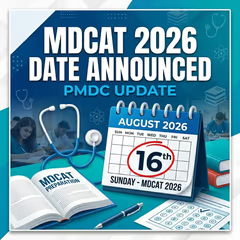
With the exam to be conducted on 16th August 2026, June is the ultimate "Sweet Spot" to begin your journey. Starting now gives you a massive 8-month window—a luxury that most students who wait until after their board exams simply won't have.
By beginning in January, you can cover the revised syllabus at a relaxed pace of just 2-3 hours a day. A great way to utilize this early start is by joining the Maqsad Akhri Mauqa Batch, which is currently focusing on 2nd Year chapters of the MDCAT syllabus.
Adopting online preparation as your primary strategy ensures you aren't overwhelmed later in the year, giving you the confidence to stay consistent while others are just beginning to catch up. By tackling these chapters now at the ease of your home, you gain the flexibility to study on your own terms, turning every college free period or commute into a productive session for your future medical career.
Conclusion
As you embark on your MDCAT preparation 2026, remember that the exam is a marathon, not a sprint. The second year of the reformed syllabus demands a smarter approach—one that prioritizes Biology without neglecting the logical precision of Physics and Chemistry.
Securing your MBBS admission in Pakistan requires the right tools, the right mindset, and the right partner. With Maqsad, you aren't just studying; you’re mastering the exam through instant doubt-clearing, localized content, and expert guidance.
The white coat is waiting. Start your preparation with Maqsad today and turn your dream into a reality.
Frequently Asked Questions (FAQs)
How many months are enough for MDCAT preparation?
While 6 months of focused study is standard, 7-8 months is ideal for freshers balancing FSc/A-Levels to avoid burnout.
How many hours to study for MDCAT per day?
A consistent 6 to 8 hours of quality study is better than 12 hours of "passive reading."
What is the pattern 2026 for the MDCAT?
The pattern is 180 MCQs (81 Bio, 45 Chem, 36 Physics, 9 English, 9 Logical Reasoning) to be solved in 180 minutes.
What are the most challenging MDCAT topics?
Students often struggle with Bioenergetics, Transition Elements, and Electromagnetism due to their highly conceptual nature.
What is the new policy for MDCAT 2025–26?
The key changes include a 65% FSc eligibility requirement and a 45% weightage for Biology in a 180-question paper.
Is MDCAT valid for 3 years?
According to the PMDC Act 2022, the result is valid for 3 years, though you must check provincial admitting university policies for specific equivalence formulas.
Explore other universities

Popular articles