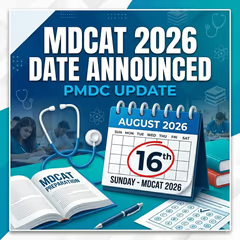

The Pakistani medical aspirant community was recently rocked by a statement from the Sindh Health Minister regarding a major shift in the MDCAT 2026 schedule. The headline-grabbing news? A proposal to conduct the Medical and Dental College Admission Test (MDCAT) just one week after the conclusion of intermediate board exams.
For a student who has spent years dreaming of a white coat, this news feels like a lightning bolt. The sudden shift in the timeline has sparked nationwide debate, with many asking: Is it even possible to prepare in 7 days?
At Maqsad, our mission is to provide clarity amidst the chaos. While the government's intent to reduce the gap year culture is understandable, the execution of a 7-day notice period faces massive hurdles. Before you let the panic take over, let’s look at the logical, administrative, and technical reasons why this timeline is virtually difficult to implement.
Table of Contents
The MDCAT 2026 Announcement
The recent discussions from the health department have suggested that the gap between FSc and MDCAT should be minimized. The main objective is to streamline the transition into medical colleges.
Fact-Checking the 7-Day Timeline
While these proposals are being discussed at the government level, it is vital to distinguish between a suggestion and a finalized PMDC notification. The MDCAT is a national-level operation involving over 150,000 aspirants. Moving such a massive exam to a 7-day window without a complete overhaul of the registration and verification system has never been successfully executed.
Why Students Are Panicking?
Panic arises when students feel they won't have the mental switch time needed to move from FSc rote learning to MDCAT conceptual logic. However, at Maqsad, we have reviewed the administrative machinery of the PMDC and provincial boards. Our analysis shows that a one-week notice is an extreme outlier that does not align with the technical requirements of conducting a fair exam.
Pro Tip: A compressed preparation window demands elite discipline. To stay ahead, focus on daily practice with MDCAT relevant questions and dedicated MDCAT books. If you're balancing board exams, develop an MDCAT study plan that helps you manage both. MDCAT video lectures online let you revise at your own pace without disrupting your FSc schedule.
4 Reasons the 7-Day Schedule is Logistically Impossible
Based on our years of experience in the MDCAT preparation, here are the four primary bottlenecks that stand in the way of a one-week notice period.
Non-Uniform Board Schedules & Practical Exams
The MDCAT is a synchronized national exam, yet our provincial boards operate on different timelines. If one province finishes their theory papers, students in another might still be giving exams. More importantly, FSc exams are followed by practical examinations that last for 2-3 weeks. Expecting you to appear for the MDCAT while you are still finishing your board requirements is physically impossible.
The PMDC Registration & Processing Bottleneck
The PMDC manages nearly 200,000 candidates annually. Traditionally, the registration portal stays open for 3 weeks to ensure students in rural areas with limited internet access can apply. Following this, the council requires at least 2 weeks to verify credentials, check the 65% eligibility rule, and issue admit cards. Attempting to fit a 5-week administrative cycle into 7 days would lead to massive system failure and student disenfranchisement.
International Venues & Overseas Aspirants
The MDCAT is a global event with centers in Saudi Arabia (KSA) . Coordinating international venues requires secure logistics, embassy coordination, and months of planning. Given the current geopolitical tensions and war situations in 2026, international exam logistics are already strained. A 7-day notice would effectively bar thousands of overseas Pakistanis from participating in the national merit.
The A-Level and CIE Schedule Clash
The current proposal seems to focus entirely on the local FSc calendar, ignoring thousands of A-Level (CIE) students. Cambridge exams follow a fixed global calendar that usually ends in June. If the MDCAT is held too early, A-Level students would be forced to choose between their high school grades and their medical career—a systemic inequality that Maqsad believes is fundamentally unfair.
Watch the full logical breakdown of these points here.
The Maqsad Solution: MDCAT Bravo Batch
In a world of shifting schedules, the only way to win is to be date-proof. You need a strategy that works whether the exam is in June or September.
The Maqsad Charlie 2.0 Batch is designed specifically to handle this uncertainty. We don't just teach the syllabus; we teach MDCAT Logic.
- Daily Live MDCAT Classes: Interact with top faculty like Sir Akbar to clear concepts in real-time.
- 10,000+ Practice MCQs: MDCAT practice tests online with 10,000+ curated MCQs mirroring the actual MDCAT difficulty level.
- Instant DoubtSolve: Stuck on a tricky numerical? Snap a photo and get a video solution in seconds via the Maqsad App.
Conclusion
The 7-day MDCAT notice is a logistical hurdle that currently lacks an official PMDC notification for the 2026 session. At Maqsad, our advice is simple: Stay focused on your current board exams. Your FSc marks are the foundation of your merit (40% weightage).
While the news may be overwhelming, remember that policy proposals often undergo several revisions before implementation. Wait for the official notification from PMDC or your admitting university.
Stay tuned to the Maqsad Blog and App for real-time updates. We are monitoring the situation closely and will be the first to inform you of any confirmed changes. Keep your head down, keep your concepts sharp, and the white coat will be yours.
Frequently Asked Questions (FAQs)
Q: Is the MDCAT 2026 syllabus the same as 2025?
Yes, the core syllabus remains the same. The PMDC continues to follow the centralized curriculum covering Biology, Chemistry, Physics, English, and Logical Reasoning.
Q: Will the early MDCAT 2026 have a reduced syllabus?
No, there is no official announcement regarding a syllabus reduction. Even if the exam date is moved earlier, the PMDC maintains a full syllabus to ensure that the merit and standards of medical education are not compromised. In a shorter preparation window, the key is to prioritize high-yield topics that appear most frequently in past papers.
Q: How long is the MDCAT 2026 result valid?
According to the PMDC Act 2022, MDCAT results are valid for 3 years. However, you must check the specific policy of your provincial admitting university, as they sometimes require the most recent year's result for their specific aggregate formulas.
Q: Does MDCAT 2026 have negative marking?
No, there is no negative marking in MDCAT 2026. You receive one mark for every correct answer, and zero marks for incorrect or skipped questions. Because there is no penalty, you should ensure that all 180 bubbles are filled on your answer sheet.
Explore other universities

Popular articles