
Every year, roughly 200,000 students sit the MDCAT. Around 4,000 get into public MBBS seats. That's a 2% acceptance rate; and the difference between the students who make it and those who don't is almost never intelligence. It's when they started.
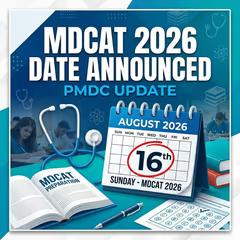
MDCAT 2027 will likely be held in August 2027. That means if you're reading this in mid-2026, you have something the August 2027 version of you would kill for: time.
This guide is a complete, month-by-month MDCAT 2027 preparation plan designed for students who want to start early and start right. No vague "study hard" advice. Just a concrete roadmap from now to test day.
Let's do the maths. The MDCAT syllabus covers roughly 40+ chapters across Biology, Chemistry, Physics, English, and Logical Reasoning. If you start in 2026, you have approximately an year before the 2027 exam.
That means you can cover the entire syllabus once, slowly, with deep understanding, and then revise it completely before the test. Students who start in April or May 2027 (as most do) get one rushed pass through the syllabus and zero revision time. The difference in scores is predictable.
Here's what early preparation actually gives you:
1. You learn concepts, not shortcuts. When you have around an year, you can actually understand why a biological process works the way it does — not just memorize a one-liner for the MCQ. Concept-based understanding is what separates 170+ scorers from 140-range students, because PMDC designs 30% of MCQs as application-level questions that pure memorization can't answer.
2. You sync MDCAT prep with your FSc Part II. If you're about to enter FSc Part II (12th grade), roughly 70% of the MDCAT syllabus comes from Part II. By starting MDCAT prep now, every chapter you study for board exams also prepares you for MDCAT — you're not doing double work, you're doing the same work once with deeper focus.
3. You have time to be weak. Starting early means you can spend 3 weeks on Organic Chemistry if you need to — without panicking. Students who start late skip their weak topics entirely because there's no time. Those skipped topics then show up as 8–10 lost MCQs on test day.
4. You avoid the repeater cycle. Over 60% of MDCAT candidates don't clear the exam on their first attempt. The single biggest reason? They started too late. Starting 14 months early is the most reliable way to avoid becoming a repeater — and losing an entire year.
This 12-month MDCAT 2027 preparation plan is designed for:
- FSc Part I students (11th grade) who will enter Part II in 2026-27 and sit MDCAT in 2027
- Current FSc Part II students who are watching the MDCAT 2026 cycle and already planning their own attempt in 2027
- O/A-Level students whose Cambridge results align with the 2027 admission cycle
- Potential repeaters from the 2026 cycle who want to start their second attempt early rather than waiting until spring 2027
If you're any of the above, the plan below fits your timeline.
PMDC announces the exact MDCAT date, registration window, and syllabus a few months before the exam each year. For 2027, nothing has been officially announced yet — but based on the consistent pattern of recent years, here's what we can reasonably expect:
The MDCAT syllabus has been largely stable for the past several years. While PMDC may make minor adjustments, the core topics remain the same — so you can begin preparation now with high confidence that what you study will be tested.
For the current syllabus that will likely carry forward, review the complete MDCAT Syllabus.
Here's the month-by-month roadmap. Adjust based on your personal schedule (board exams, holidays, etc.), but keep the overall structure intact.
Goal: Cover FSc Part I concepts that appear in MDCAT, and begin Part II chapters early.
August 2026
- Start with Biology Part I — Cell Biology, Enzymes, Bioenergetics, Biological Molecules. These are foundational chapters that everything else builds on.
- Chemistry Part I — Atomic Structure, Chemical Bonding, Stoichiometry. Get the basics locked in before Organic Chemistry enters the picture in Part II.
- Physics Part I — Measurements, Vectors, Motion. These aren't heavily tested in MDCAT, but the problem-solving approach you build here carries forward.
- Use a to build concepts — watch at 1x speed during this phase, not 2x. Understanding matters more than speed right now.
September – October 2026
- Continue Biology Part I — Genetics (Variation & Inheritance), Cell Division, Kingdom classification.
- Chemistry Part I — Gases, Liquids, Solids, Thermochemistry, Electrochemistry.
- Physics Part I — Work & Energy, Circular Motion, Waves.
- Begin solving topical MCQs after each chapter — not full papers yet, just chapter-wise practice to test retention.
Checkpoint: By end of October, you should have covered approximately 60–70% of Part I across all three science subjects. English and Logical Reasoning don't need dedicated time yet — they'll come later.
Goal: Cover FSc Part II chapters alongside your board preparation. This is the highest-yield phase — Part II content makes up ~70% of MDCAT.
November – December 2026
- Biology Part II — Coordination & Control, Reproduction, Support & Movement, Life Processes. These are MDCAT-heavy chapters.
- Chemistry Part II — Begin Organic Chemistry (Hydrocarbons, Alkyl Halides, Alcohols & Phenols). Organic is the section most students struggle with — starting it 9 months before the test gives you time to actually understand mechanisms.
- Physics Part II — Electrostatics, Current Electricity. Numericals-heavy — practice problems daily.
- Start attending live MDCAT classes if available — they force a schedule and prevent drift.
January – February 2027
- Biology Part II — Evolution, Prokaryotes, Diversity Among Animals.
- Chemistry Part II — Aldehydes & Ketones, Carboxylic Acids, Macromolecules. Also cover Chemical Equilibrium and Reaction Kinetics from Part I if not already done.
- Physics Part II — Electromagnetism, Electromagnetic Induction, Electronics, Nuclear Physics, Modern Physics.
- Begin weekly MCQ practice — 50 MCQs per sitting, timed. Not full papers yet, but getting used to the clock.
March 2027
- Board exam preparation month. Don't panic about MDCAT — if you've been following this plan, your board prep IS your MDCAT prep for Part II. Focus on boards, score well (your FSc marks contribute to your MDCAT aggregate), and trust that you'll return to MDCAT-specific practice in April.
Checkpoint: By end of March, you should have covered 80–90% of the MDCAT syllabus across all subjects. The remaining chapters are likely fringe topics that carry 1–2 MCQs each.
Goal: Close remaining syllabus gaps, begin full-length papers, and sharpen weak areas.
April 2027
- Complete any remaining chapters (English grammar, Logical Reasoning, any skipped Biology/Chemistry topics).
- Begin full-length mock tests — one per week, timed, under exam conditions.
- Review every mistake from mock tests — the chapters where you're losing marks are your revision priorities.
- Start English preparation — Grammar (tenses, subject-verb agreement, prepositions), Vocabulary, Reading Comprehension. 15 MCQs is a small section, but "easy marks" only if you've practiced.
May 2027
- Increase mock frequency — two full-length papers per week.
- Focused revision of high-yield chapters: Genetics, Organic Chemistry, Electrostatics, Coordination & Control.
- Practice Logical Reasoning (Critical Thinking, Letter & Symbol Series, Logical Deduction, Cause & Effect). This section is pure practice — no amount of theory replaces doing 100+ reasoning MCQs.
June 2027
- MDCAT registration likely opens this month — register immediately, don't wait for the deadline.
- Three full-length papers per week now. Analyze every paper: what did you get wrong, why, and which chapter does it belong to?
- Final revision of weak areas identified from mock tests.
- Use the MDCAT Aggregate Calculator to set your target score based on your expected FSc marks — this gives you a concrete number to aim for rather than a vague "score well."
Goal: Peak performance. No new learning — only revision, practice, and mental preparation.
July 2027
- Daily full-length papers (or every other day, with analysis days in between).
- Rapid-fire revision — 30-minute daily sessions on one chapter each, rotating through Biology → Chemistry → Physics.
- Finalize your exam-day strategy: which subject to attempt first, how many minutes per section, when to skip and come back.
- Register for NUMS MDCAT separately if targeting military medical colleges.
August 2027 (Test Month)
- First week: Final 2–3 full papers. Identify any last remaining gaps. Light revision only — no cramming.
- Two days before: Stop studying. Rest, eat well, prepare your documents (admit card, CNIC, stationery).
- Test day: Arrive early, stay calm, trust your 12 months of preparation. You've done more work than 90% of the room.
Biology carries the most MCQs in the MDCAT. It's primarily recall-based (70%), with 30% application questions. The key is systematic coverage — there are no shortcuts.
High-yield chapters: Coordination & Control, Variation & Genetics, Life Processes (Nutrition, Gaseous Exchange, Transport), Biological Molecules, Cell Structure & Function, Reproduction, Bioenergetics.
Strategy: Read the textbook line by line (not summary notes) for Biology. PMDC pulls MCQs from specific sentences — students who read summaries miss the details that become MCQs. After each chapter, solve 30–50 topical MCQs immediately.
Chemistry is split between Physical/Inorganic (Part I) and Organic (Part II). Organic Chemistry is where most students struggle — reactions, mechanisms, nomenclature.
High-yield chapters: Chemical Bonding, Chemical Equilibrium, Organic Chemistry (Hydrocarbons through Carboxylic Acids), Electrochemistry, Reaction Kinetics.
Strategy: For Physical/Inorganic, focus on understanding concepts and practicing numerical-type MCQs. For Organic, there's no substitute for writing out reaction mechanisms by hand — apps and videos help, but hand-writing builds the muscle memory that sticks during the exam.
Physics has the fewest MCQs but the highest difficulty perception. It's numericals-heavy — you need to solve problems, not just read theory.
High-yield chapters: Force & Motion, Electrostatics, Current Electricity, Electromagnetic Induction, Waves, Work & Energy.
Strategy: Solve 10 numerical problems daily from Day 1. Physics improves through practice, not reading. After covering each chapter, do 20–30 topical MCQs focusing on formula application and unit conversion — these are the most common PMDC traps.
Small section, but free marks if prepared. Covers grammar, vocabulary, sentence correction, and reading comprehension.
Strategy: Daily 15-minute grammar practice (tenses, prepositions, subject-verb agreement). Read one English editorial per day from Dawn or The News to build comprehension speed. Start this habit in April 2027 — 4 months of daily practice is more than enough.
Pure practice section. No textbook content — just pattern recognition and critical thinking.
Strategy: Start practicing in April 2027. Do 10 Logical Reasoning questions daily — Critical Thinking, Letter & Symbol Series, Logical Deduction, Course of Action, Cause & Effect. Speed matters here — these questions should take under 1 minute each.
Starting early is the biggest advantage — but it's not a guarantee. Here are the mistakes that waste the early-start advantage:
1. Starting without a plan. Opening a Biology textbook on Day 1 without knowing which chapters to cover, in what order, or by when, leads to drift. Follow the 12-month plan above — or adapt it to your timeline — but have a written plan.
2. Studying passively. Watching video lectures without solving MCQs afterward gives you a false sense of progress. Every chapter should end with 30–50 MCQs. If you can't answer them, you didn't learn the chapter — you just watched it.
3. Ignoring Part I. Students assume "Part II is 70% of MDCAT, so I'll skip Part I." But MDCAT Part I questions are often the easiest marks on the paper — Stoichiometry, Cell Biology, Measurements — and skipping them means giving away free points.
4. Not taking mock tests early enough. Mock tests aren't just for the last month. Start monthly mocks from January 2027 and weekly mocks from April. Early mocks aren't about scoring high — they're about identifying what you don't know while there's still time to fix it.
5. Burning out before the exam. 14 months is a long preparation window. Students who study 8 hours/day from Day 1 burn out by March. Instead, start with 2–3 hours/day of focused MDCAT study (separate from board prep) and gradually increase to 5–6 hours/day by June 2027. Consistency beats intensity.
Here's what a complete MDCAT 2027 preparation toolkit looks like:
Syllabus & structure: The MDCAT Syllabus gives you the full topic-wise breakdown — use it as your checklist throughout the 12 months.
Video lectures: MDCAT video lectures cover every chapter at FSc depth — ideal for concept building in Phase 1–2 and quick revision in Phase 3–4.
Live classes: Daily live MDCAT classes provide structured coverage with expert teachers. Especially valuable from November 2026 onwards when Part II content gets dense.
Practice tests: MDCAT practice tests with 10,000+ MCQs and full-length papers. Start with topical MCQs in Phase 1, shift to full papers in Phase 3.
Aggregate calculator: The MDCAT Aggregate Calculator lets you set a concrete target score based on your Matric and FSc marks — so you know exactly what MDCAT score you need for your target college.
NUMS preparation: If you're also targeting military medical colleges, the NUMS MDCAT is a separate exam with a slightly different structure (200 MCQs including a psychological test). Review the NUMS MDCAT 2026 announcement blog for the latest pattern — the 2027 structure will likely be similar.
For the complete structured experience — video lectures, live classes, MCQ bank, and mock tests in one platform — explore the Maqsad.
Now. The earlier you start, the more time you have for deep concept building, full syllabus coverage, and extensive mock practice. Students who start 12–14 months before the exam consistently outperform those who start 3–4 months before.
The PMDC MDCAT syllabus has been largely stable for several years. While minor adjustments are possible, the core subjects (Biology, Chemistry, Physics, English, Logical Reasoning) and topic areas remain the same. You can safely begin preparation using the current syllabus.
Start with 2–3 hours of focused MDCAT-specific study daily (in addition to your board prep). Gradually increase to 4–5 hours by April 2027 and 5–6 hours in the final stretch (June–August). Consistency is more important than marathon sessions.
Yes — and you should. Roughly 70% of the MDCAT syllabus comes from FSc Part II. By aligning your board study with MDCAT prep, you cover both simultaneously. The key is to go deeper than board-level on each chapter (solve MDCAT-style MCQs after studying each topic).
Based on the consistent pattern, MDCAT 2027 will likely be held in mid-August 2027 (Sunday). NUMS MDCAT is typically one week earlier or later. Official dates will be announced by PMDC in early 2027.
No. MDCAT has had no negative marking since 2020. Attempt every question.
It varies by province and college, but competitive candidates typically need 170+ out of 180 in MDCAT, combined with 90%+ in FSc, to secure public MBBS seats in Punjab. Use the MDCAT Aggregate Calculator to set your specific target.
If you want to maximize your college options (including Army Medical College, CMH colleges, Bahria, NUST School of Health Sciences), then yes. NUMS MDCAT is a separate exam with 200 MCQs (150 subject + 50 psychological test). The core subjects overlap with the National MDCAT, so preparing for one helps with the other.
Maqsad offers daily live classes, 10,000+ MCQs with video solutions, recorded lectures, weekly tests, and full-length mock papers — all aligned to the PMDC syllabus. It's the most complete MDCAT preparation platform available.
Explore other universities

Popular articles